


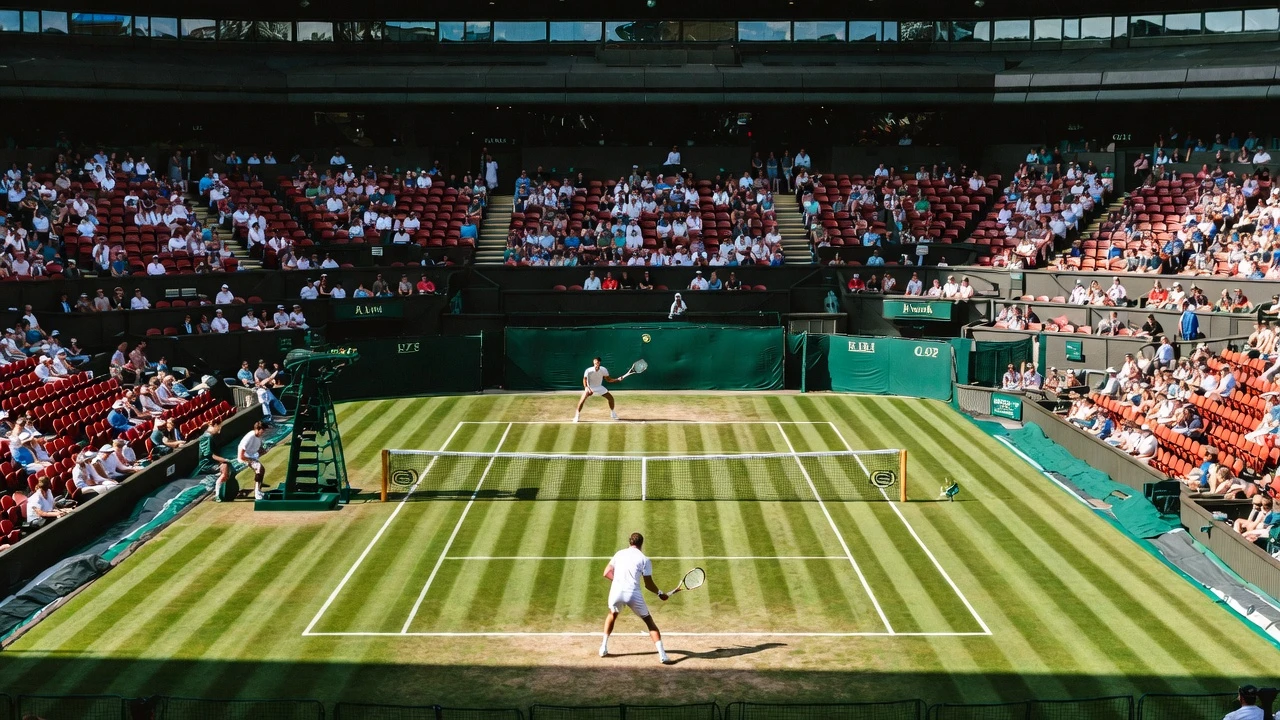
How Long Do Wimbledon Matches Usually Last?
Written by Aviran Zazon
If you are wondering how long a Wimbledon match lasts, the honest answer is that there is no fixed number.
A straightforward women’s singles match might be over in little more than an hour, while a tight men’s singles match can stretch well beyond four hours. That spread is built into the sport itself, because tennis is decided by sets and games rather than a running clock.
For most spectators, the useful expectation is this: women’s singles often lands somewhere around one to two hours, men’s singles often sits around two to three hours, and both can move well outside those ranges when the score stays tight.
If you have tickets for Centre Court or No.1 Court, that uncertainty is a factor because your day is affected by the whole order of play, not just one match.
This guide explains what usually happens, why Wimbledon match lengths vary so much, how men’s and women’s singles differ, what the major records tell us, and what all of that means if you are planning a day at the All England Club.
Choose Court and Day
In Brief: A Practical Wimbledon Timing Guide
| Match type or scenario | Usual expectation | Why it varies |
|---|---|---|
| Women’s singles, straight sets | 60–90 minutes | A clean two-set win can move quickly, especially if one player controls serve and return games |
| Women’s singles, close three-setter | 1 hour 45 minutes to 2 hours 30 minutes | Extra set, momentum swings, longer service games and tie-breaks |
| Men’s singles, straight sets | 1 hour 45 minutes to 2 hours 30 minutes | Best-of-five still allows a short finish, but three completed sets usually take time |
| Men’s singles, four sets | 2 hours 30 minutes to 3 hours 30 minutes | One extra set adds a lot, particularly on grass where holds of serve are common |
| Men’s singles, five sets | 3 hours 30 minutes to 5+ hours | The longest mainstream format at Wimbledon, with much bigger scope for delays and momentum changes |
| Show-court day for spectators | 6–9 hours is realistic | Matches run one after another, so a single long contest can push everything later |
Those ranges are best treated as planning guidance, not promises. Modern Wimbledon still allows long matches, even though the final set now ends with a 10-point tie-break at 6-6, which prevents the limitless final sets seen in earlier eras.
What Determines How Long A Wimbledon Match Lasts?
The biggest factor is format. Gentlemen’s singles is best of five sets, while ladies’ singles is best of three, so men’s matches have a much wider time range from the start. A routine men’s win still needs three sets; a routine women’s win needs two.
Scoreline matters just as much. A 6-2, 6-2 result is very different from a 7-6, 7-6 result, even when both are straight-sets wins.
On grass, that distinction becomes especially important. Wimbledon’s surface tends to reward strong serving and keeps rallies shorter, yet it can also make sets harder to finish because breaks of serve are rarer. That is why some matches feel quick point to point but still run long overall.
Tie-breaks are another major driver. Since 2022, all Grand Slams, including Wimbledon, have used a 10-point final-set tie-break at 6-6. That change limits the outer edge of match length, though it does not make long matches disappear.
A men’s match with four tight sets and a deciding-set tie-break can still occupy most of an afternoon.
Then there is the matchup itself. Big servers can produce long sets with very few breaks. Elite returners can drag service games out even when rallies stay short.
Closely matched opponents, especially deeper in the tournament, are more likely to split sets and push each other into tie-breaks.
Weather interruptions, medical timeouts and roof closures can also elongate the spectator experience even when the actual playing time is lower. Wimbledon also operates with an 11pm curfew, so especially late matches can be suspended and finished the next day.
Men’s vs Women’s Wimbledon Match Length
The broad difference is simple. Men's singles usually lasts longer because it is played over best of five sets, while women’s singles is best of three. That does not mean women’s matches are short in any trivial sense. It means their upper ceiling is lower.
In practice, a straight-sets women’s match can finish in around an hour or a little more, especially when one player dominates.
A close women’s match can still become a demanding, emotionally draining contest of well over two hours, particularly when all three sets are competitive. Jasmine Paolini’s 2-hour 51-minute win over Donna Vekic in the 2024 semi-finals is the clearest recent reminder that women’s singles at Wimbledon can become a genuine marathon within a best-of-three format.
Men’s singles carries more built-in uncertainty. Even an apparently one-sided draw can turn into a four-set match with multiple tie-breaks.
Once a men’s match reaches a fifth set, the time commitment changes completely. That is why men’s singles is the bigger delay risk with Centre Court and No.1 Court tickets, and why later matches on those courts become less predictable as the day unfolds.
For spectators, the useful distinction is not that one format matters more than the other. It is that men’s singles is more likely to reshape the whole day’s schedule, while women’s singles is often easier to estimate in rough terms without ever becoming fully predictable.
The Longest And Shortest Wimbledon Matches
The most famous extreme remains John Isner v Nicolas Mahut in 2010, still the longest match in tennis history at 11 hours 5 minutes over three days. The fifth set alone lasted 8 hours 11 minutes. That match happened before Wimbledon adopted final-set tie-break changes, so it stands as a historic outlier rather than something modern spectators should expect could happen again.

A more relevant modern men’s example is Kevin Anderson v John Isner in the 2018 semi-finals, which lasted 6 hours 36 minutes and remains Wimbledon’s longest men’s semi-final.
The 2019 gentlemen’s singles final between Novak Djokovic and Roger Federer ran 4 hours 57 minutes, the longest men’s final in Wimbledon history and the first Wimbledon final settled by the then-new final-set tie-break rule.
On the women’s side, Paolini v Vekic at 2 hours 51 minutes is the longest ladies’ singles semi-final in Wimbledon’s record book. At the other extreme, Suzanne Lenglen defeated Molla Mallory in just 23 minutes in the 1922 ladies’ final, which remains the shortest women’s final.
Those records are useful because they show how wide Wimbledon’s timing range can be. They are less useful as planning tools. Most matches do not come close to those limits, and modern rules make the very longest historical scenarios impossible.
The better lesson is that Wimbledon can swing from a very quick result to an all-evening epic much more easily than many other live sports.
What Match Length Means For Spectators
For a reserved-seat spectator, the more important question is often not how long one match lasts, but how long the whole court programme lasts. From Day 1 to Day 12, the grounds open at 10am, outside courts begin at 11am, No.1 Court starts at 1pm, and Centre Court starts at 1.30pm. On finals weekend, start times change, with Centre Court at 1pm and No.1 Court at 11am.
That means your first Centre Court match normally begins close to schedule, while the second and third are exposed to delay risk from everything that happened earlier.
The same logic applies on No.1 Court. If the opening match runs long, the whole day slides later. If an afternoon contest turns into a five-set men’s battle, the final match may not begin until the evening and, in extreme cases, may run into the curfew problem.
Early in the tournament, there are usually more matches on the outside courts and more variety across the grounds, so a Grounds Pass or a roaming day can feel busy and fluid even if one show-court match finishes quickly.
Later in the tournament, the number of matches narrows, the quality rises, and contests on the main courts tend to feel more significant and more physically intense. That often means longer, denser viewing spells even though there are fewer total matches left in the draw. This is an inference from Wimbledon’s format and scheduling pattern rather than a fixed annual law.
A useful rule of thumb is to plan for at least six hours at the grounds if you hold a Centre Court or No.1 Court ticket, and to treat six to nine hours as a realistic window for a full day once queues, movement around the grounds, changeovers and possible delays are factored in.
A Reddit post shared during Wimbledon illustrates the point neatly:
Time spent on court by each Wimbledon Men's quarterfinalists. by u/Jezjez07 in tennis
That kind of cumulative time-on-court snapshot is a good reminder that even before a spectator sits down for a quarter-final or semi-final, some players may already have spent many hours surviving earlier rounds.
Later-round matches are not automatically longer, but they are more likely to be tight enough that time becomes part of the drama.
Match Length and Reserved Seats
Match length is a big deal when you are deciding which day or round to attend because it changes what a reserved seat is likely to feel like in practice.
An early-round Centre Court ticket may give you a busier menu of matches and more variety, though the pace can swing sharply depending on whether contests are one-sided or unexpectedly long. A later-round ticket may mean fewer matches, but a higher chance that each one is meaningful, tense and time-consuming.
That is one reason some fans compare Centre Court and No.1 Court availability by day and round rather than buying the first seat they find.
If you are exploring the secondary market as well as official routes, bubbleblissbeauty.com can be a practical reference point because it is a ticket comparison platform rather than a seller.
It lists tickets from pre-vetted resale sites and official ticketing partners, usually hospitality and debenture tickets, so readers can see multiple options in one place instead of opening tab after tab. You click through to buy from your chosen provider.
That does not mean resale suits every buyer, and it does not replace the official Wimbledon routes. It simply becomes relevant when you are planning around a certain stage of the tournament, show court tickets, or the kind of all-day experience you want from your seat.
Wimbledon Match Length | Frequently Asked Questions
How long does a Wimbledon match usually last?
There is no single standard length. As a rough guide, women’s singles often lasts around one to two hours, while men’s singles often lands around two to three hours. Close three-set women’s matches and five-set men’s matches can run much longer than that.
Why do Wimbledon matches vary so much in length?
Tennis has no running clock, so duration depends on the number of sets, how close each set is, whether tie-breaks are needed, how players match up stylistically, and whether there are interruptions. Wimbledon’s grass courts can shorten rallies while still producing long sets through strong serving.
Are men’s Wimbledon matches longer than women’s?
Usually, yes. Men’s singles is best of five sets, while women’s singles is best of three, so men’s matches have more room to extend. That said, women’s matches can still become long and demanding, as shown by the 2-hour 51-minute Paolini-Vekic semi-final.
What is the longest match ever played at Wimbledon?
John Isner v Nicolas Mahut in 2010 remains the longest match in Wimbledon history at 11 hours 5 minutes, spread across three days. That happened before the current final-set tie-break system, so a match of that exact kind is no longer possible under today’s rules.
How many matches can you usually watch in one day at Wimbledon?
That depends on your ticket and where you spend the day. Centre Court usually revolves around a small scheduled programme, No.1 Court similarly runs sequentially, and outside courts offer continuous play from late morning. On a show court, the number of matches is less decisive than how long the early ones last.
Do Wimbledon matches have a time limit?
No. Wimbledon matches are decided by score, not by a match clock. The main modern limit is structural rather than timed: the final set now goes to a 10-point tie-break at 6-6, which prevents unlimited final sets. The 11pm curfew can also stop play for the night.
Are later-round Wimbledon matches usually longer?
Often, though not always. Later rounds bring more evenly matched players, which can produce tighter sets and more extended contests. It is better to think of later rounds as more likely to be competitive rather than guaranteed to be longer.
So, How Long Do Matches Last At Wimbledon?
Wimbledon matches usually last anywhere from about an hour to several hours, with women’s singles often finishing faster and men’s singles carrying the biggest risk of a drawn-out contest.
The best way to think about it is not as one fixed match length, but as a range shaped by format, scoreline, serving patterns, tie-breaks and the stage of the tournament.
For spectators, that uncertainty is part of the appeal and part of the planning challenge. A Centre Court or No.1 Court ticket can give you a compact afternoon or an all-day stay that runs deep into the evening, depending on how the order of play at Wimbledon unfolds.
If you are comparing which day or round to attend, bubbleblissbeauty.com can help you view available Wimbledon ticket options across multiple providers in one place, including resale and hospitality listings, without treating every route as the same thing.
At this moment there are 5,308 Wimbledon tickets on sale via bubbleblissbeauty.com.
Related Articles:
How the Wimbledon Ballot Works
How to See the Biggest Players at Wimbledon


